


Too meek, too mild, too polite

Scott Harlum is the current President of the National Association of People With HIV Australia (NAPWHA), serving his third two-year term in the role after joining the Board as Treasurer in 2014.
Scott is also a Director of Health Equity Matters, formerly the Australian Federation of AIDS Organisations; a Director of Australia’s peak national ‘health consumer’ organisation, the Consumers’ Health Forum of Australia; and, in 2023, was appointed by Minister for Health, Mark Butler, to represent people living with HIV on the Federal HIV Taskforce, which was tasked with setting a course for Australia to achieve the virtual elimination of domestic transmission of HIV by 2030.
Scott has lived experience of HIV, chronic kidney disease, haemodialysis and renal transplant – he received his second donor kidney transplant in June 2024.
Scott has professional experience in governance, strategic planning, health policy, media and communications, marketing and public relations. He was previously the Principal Policy Officer to the Chief Health Officer of Queensland, and has worked as a print journalist.
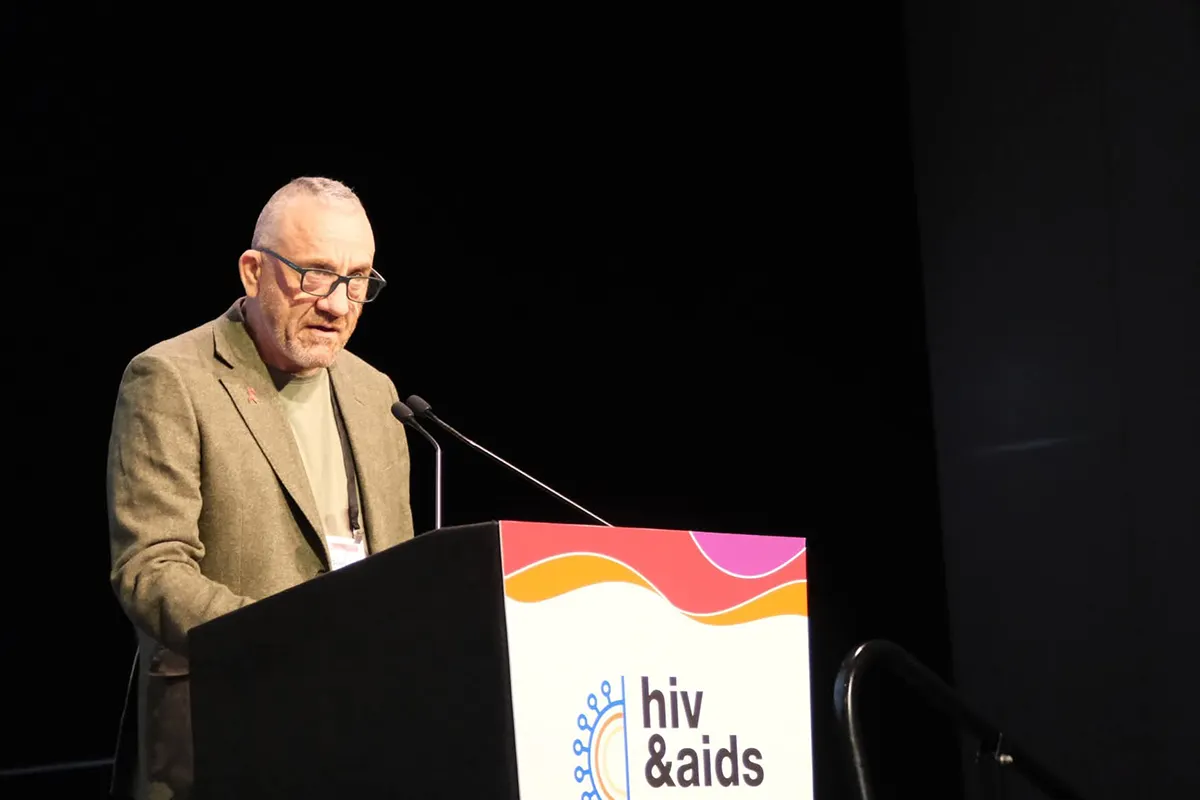
Good morning,
I acknowledge the traditional owners of these lands and pay my respects to elders past and present.
I also acknowledge all people with HIV – those living and those lost – and particularly acknowledge people living with HIV here today and here in Adelaide for the conference.
My task this morning is a straightforward one – on behalf of NAPWHA and people with HIV, to welcome you to the conference.
So, I do that! Welcome all to the ASHM conference for 2025. Thank you, James and Alexis and the whole team at ASHM who work tirelessly every year to pull this roadshow together, and to craft an engaging and informative program.
For the rest of my time, a call to action:
It’s been now two and a half years since the first meeting of the HIV Taskforce, co-chaired by Minister for Health, Mark Butler himself and, as she was then, Assistant Minister for Health, Ged Kearney, and tasked with charting a path for Australia to achieve the virtual elimination of domestic HIV transmissions by 2030.
It’s now nearly 12 months since the release of the Ninth National HIV Strategy, which gave effect to the vision set out by the Taskforce.
And, soon it will be 2030, and just as the last two and a half years have, the time between now and 2030 will pass in what feels like the blink of an eye.
It is time, in fact it is past time, for the ‘rubber to hit the road’ and for us to do the work that’s needed to drive down new HIV notifications and to achieve that aspirational goal of the virtual elimination of HIV transmissions in Australia (or less than 91 new notifications annually) by 2030.
It is not and was never going to be easy. The ‘easy’ has been done – what’s left to do in our national HIV response (to achieve virtual elimination) are the ‘difficult’, so we need to focus our efforts, and we need to work harder than ever.
Now is not the time to be too meek, too mild, or too polite! Now is the time to act, to speak your mind, to share your ideas and your thoughts, and to play your part to prevent hundreds from acquiring HIV.
For NAPWHA, part of our not too meek, not too mild and not too polite approach, is HIVtest.au, our HIV self-test service, delivered in partnership with Queensland Positive People, our Member from that State.
Informed by our own lived experience of the reasons health systems have failed to prevent us acquiring HIV, we knew that in order to get everyone who needed to, to test for HIV, we needed to remove the barriers to them doing so.
We needed for anybody who assessed themselves at risk of HIV to be able to access a HIV test, so they knew their status, could seek out treatment, get on ARV medication as quickly as possible to prevent the virus doing long term damage to their bodies, and to minimise onward transmission of the virus by them, with their unchecked viral loads.
It wasn’t easy. It was difficult. We faced a lot of opposition and a lot of criticism, but we pushed on, and now thousands and thousands of HIV self-test kits have gone out, free, delivered in discrete packaging, direct to the door of those who’ve asked us for them.
So large are our orders now, that the provider of the kits has to declare those orders to the market. The orders are so large that the continuous market disclosure requirements for a publicly listed company in Australia require it, such is the potential for the orders to move the market and their share price.
But the sheer number of tests is not the measure of our success. That measure is in the data we get back, the survey data we get back from those people who’ve ordered a test kit via HIVtest.au
The measure of our success is in the data that tells us the number of people accessing a test kit who share, via our survey, that they have never before tested for HIV. That number is mind-blowingly high. The number who share that they’ve not tested for HIV within the last two years, is mind-blowingly higher!
I don’t want to speak too soon, but our survey data may be indicating that, finally, those people we used to call ‘hard to reach’ for HIV testing are accessing HIV test kits via HIVtest.au. We may just, finally, be breaking into that persistent group of 3500, or whatever the correct estimate may be, of people with undiagnosed HIV in Australia, via who the bulk of new transmissions of HIV in Australia might be traced.
So, if you remain a critic of HIVtest.au and of in-home HIV self-testing, then please, hunt me down in the hallways of this conference and let’s chat.
Too meek, too mild, too polite, neither I nor NAPWHA will be as we play our part in reaching the virtual elimination by 2030 goal, and I encourage each of you to adopt a similar approach.
NAPWHA, our member organisations, and the community of people with HIV, we have more to do to contribute. And I know that many of you are also contributing, in many different ways to the virtual elimination goal.
Come 2031 or 2032, let’s not look back with regret that we’ve been too meek, too mild or too polite, and not given everything we’ve got to seizing the opportunity we’ve been given to continue to show the world what a global benchmark HIV response can achieve when all of its parts work together toward an aspirational common goal.
Related posts

Farewell, my friend
We were an item in the early eighties before we were even aware that HIV was circulating among us although we’d heard reports about this mysterious virus, initially called GRID (Gay Related Immune Deficiency) coming from the USA. When the HIV test became available in November 1984 we both made a quick dash to the […]

Heterosexual men living with HIV in Australia
The only thing worse than being talked about is not being talked about.
AIDS2026: Is HIV remission the new cure?
AIDS2026 offered a glimpse into the “just around the corner” future of HIV treatment and care.
