


From long-acting to a functional cure

Heather Ellis has lived with HIV since 1995. She is an HIV advocate, published author, journalist and motorcycle adventurer. Heather’s two books are the best-selling travel memoirs: Ubuntu: One Woman’s Motorcycle Odyssey Across Africa and Timeless On The Silk Road: An Odyssey From London to Hanoi. Heather is the communications and engagement coordinator for Positive Women Victoria based in Melbourne, a member of the National Network of Women Living With HIV Australia; and is a member of the community advisory board for the Melbourne HIV Cure Consortium. Read more about Heather at: www.heather-ellis.com

Heather Ellis was awarded an IAS scholarship to attend the 13th IAS Conference on HIV Science in Kigali, Rwanda from 13 to 17 July 2025.
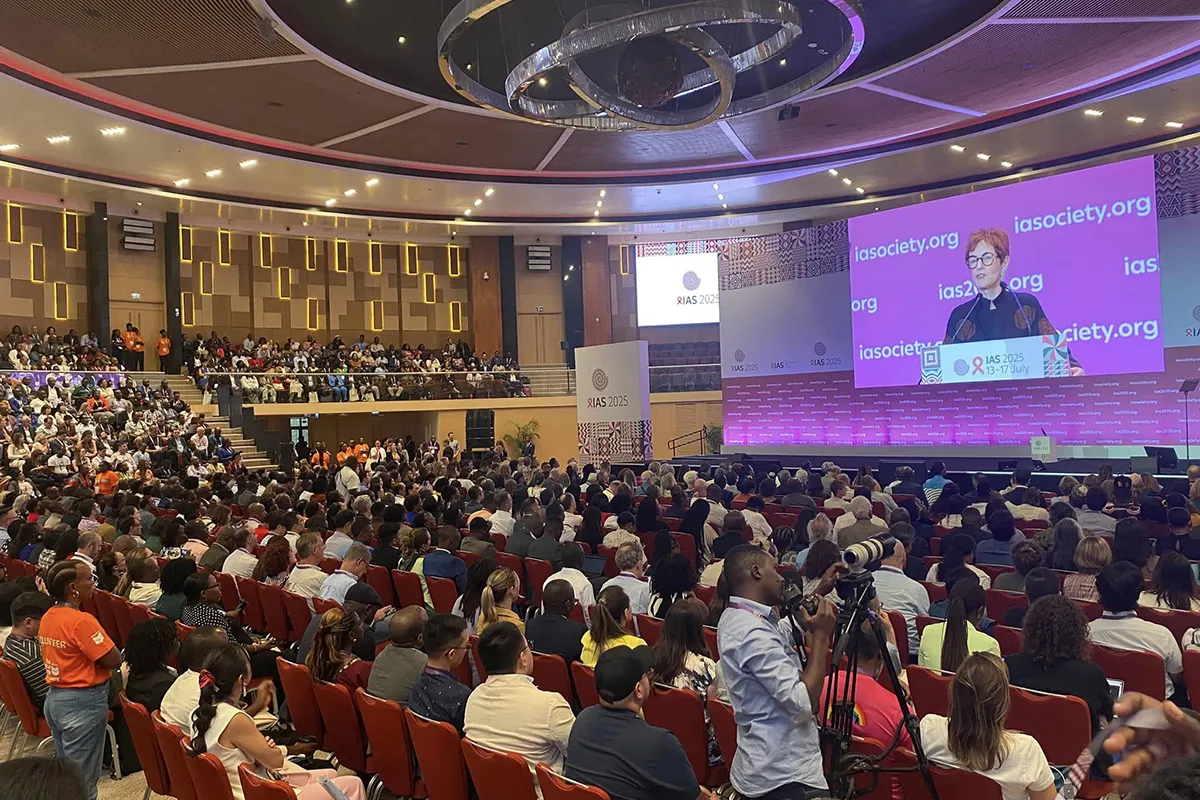
IAS President Beatgriz Grinsztejn welcomes delegates to IAS 2025 in Kigali, Rwanda.
Long-acting HIV treatments; PrEP that could end the HIV epidemic; and the ongoing promise of a functional cure using bNAbs were just some of the highlights at the 13th IAS Conference on HIV Science held in Kigali, Rwanda in July. But US aid funding cuts threaten research progress, access to treatment, testing and prevention for many.
With long-acting HIV prevention and treatments taking centre stage, many delegates dubbed IAS 2025 the “Lenacapavir Conference.” And rightly so. This new injectable for PrEP (pre-exposure prophylaxis), which has also made its way into several weekly and long-acting HIV treatments, has the potential to end the HIV epidemic. It is FDA approved in the US and the World Health Organization (WHO) released guidelines at IAS 2025 for its roll out globally. But this depends on funding.
With the United States government slashing aid to global HIV programs in January, the rollout of lenacapavir PrEP may well rely on new donors.
However, some of the US aid funding has since been reinstated. For African countries, many of which are heavily dependent on this support, holding IAS 2025 in Africa brought the funding crisis into sharp focus.
Rwanda was highlighted as an example of progress and resilience. In the aftermath of the 1994 genocide when nearly one million Tutsi and moderate Hutu were massacred, the country has rebuilt. Today, Rwanda offers free education and healthcare, including HIV treatment to 230,000 people. It is among the few African nations to achieve the UNAIDS 95-95-95 targets, supported by income from mining and agricultural exports and a booming tourism industry, particularly gorilla trekking.
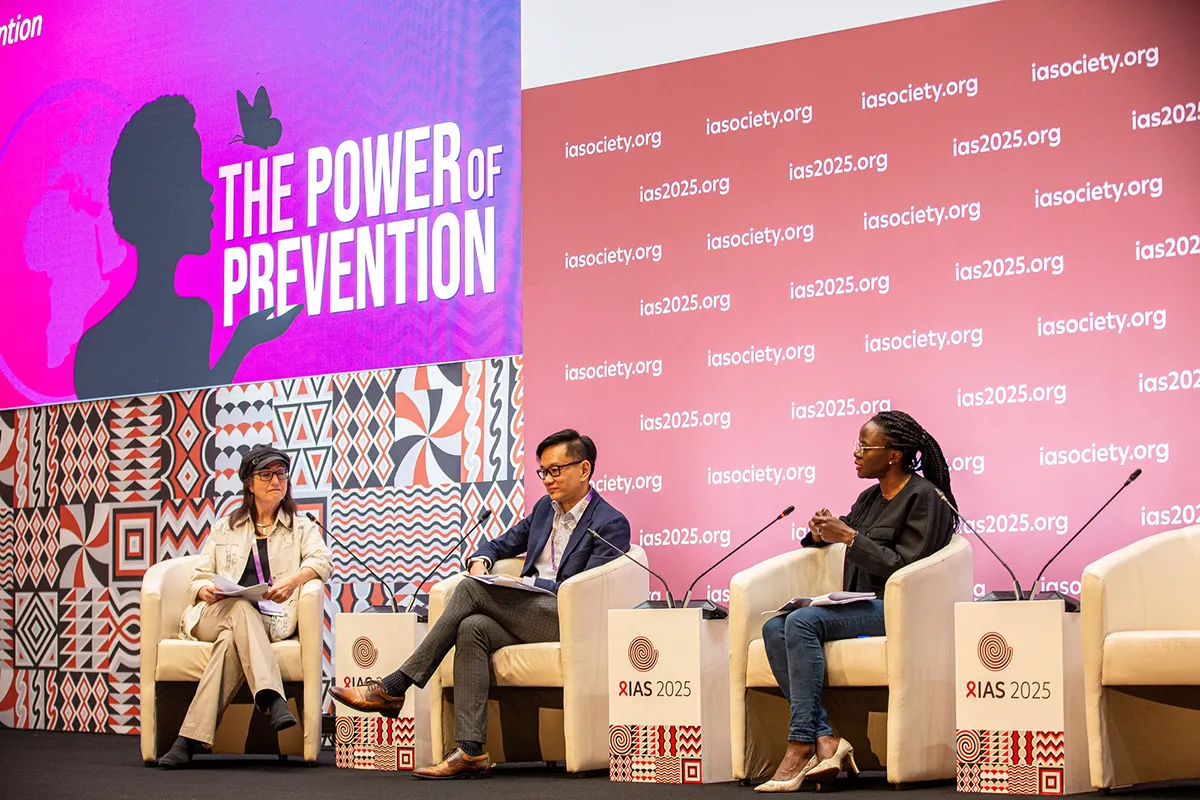
Prevention as PrEP was a major focus of IAS 2025
While PrEP dominated many sessions, optimism also grew around advances toward a functional cure, though a complete cure remains as elusive as ever.
What is lenacapavir or LEN?
Called by some as a miracle HIV drug, lenacapavir as PrEP could be a ‘game changer’ in preventing millions of HIV transmissions, but it is also a powerful HIV treatment.
Firstly, LEN is in a class of its own. It is a capsid inhibitor, discovered by US biochemist Wesley Sundquist about 25 years ago and later developed by Gilead Sciences. Lenacapavir targets the HIV capsid — the protein shell essential for the virus to replicate.
HIV Treatments in 2025 and beyond
So where are we in 2025 with new HIV treatments? There are more daily HIV treatments with only two drugs; weekly orals are about three years away with three different weekly antiretroviral (ARV) pills in clinical trials; and long acting injectable-infusion based HIV treatments for six months or even longer also hold promise. However, such injectable-infusion HIV treatments are expensive and once past clinical trials, will mostly be unavailable in low to middle income countries. High income countries, like Australia, may also avoid government PBS approval because existing cheaper HIV medications work and are well tolerated by most people with HIV.
The weekly oral pill coming to you soon
Lenacapavir is also in a weekly pill combined with the HIV drug Islatravir, which has been around for many years. This ISL/LEN weekly ARV pill is now in phase 3 clinical trials in many countries including Australia. The Phase 3 two-year trial ends in late 2026 and it is hoped this weekly pill will be available here sometime in late 2027. Results from Phase 2 trials showed 94 per cent of participants achieved an undetectable viral load after 48 weeks and side effects were minimal with 3.3% experienced diarrhoea, fewer than 2% reported fatigue and there was no significant weight gain. Participants also reported that the weekly oral reduced pill burden, improved adherence and quality of life while others reported there was less risk of disclosure.
Long acting injectables preferred
Cabotegravir + rilpivirine is another long acting injectable HIV treatment given every two months. It’s already available in Australia with some people loving it while others say the injection is too painful. But this CAB/RPV combo also received attention at IAS2025 with strong adherence and high patient satisfaction over a two year follow up. This long-acting combination can also be used as PrEP, with an early clinical trial to push out the dosage to four months instead of two, currently in progress. At the moment, long-acting injectable CAB/RPV is not subsidised for PrEP in Australia.
The future of long-acting HIV treatments
Alongside six-monthly PrEP, lenacapavir (LEN) is available in Australia as a six-monthly injectable for people with multi-drug resistant HIV, though it still must be paired with another ARV, usually a daily pill. Researchers remain cautious about monotherapy (using one ARV on its own), but there are growing calls for urgent trials pairing LEN with cabotegravir (CAB) in the one injection. While CAB is currently dosed every two months, combining the two would give LEN a ‘buddy’ ARV.
IAS 2025 also highlighted the need for more research on long term injectable ARVs in pregnant women. So far, small studies of LEN and the CAB/rilpivirine combo (around 250 participants total) suggest safety, but larger trials are needed.
An HIV drug implant based on dolutegravir showed promise in mice but was abandoned in humans after one-third experienced skin reactions. Researchers have gone back to the lab so let’s see if implants could still deliver long-term HIV therapy using existing ARVs.
Ultra long-acting in relation to HIV treatments and PrEP was also a term that came up in some sessions so could we see HIV treatments longer than six months in the future? PrEP as lenacapavir is already in clinical trial for a one year injection.
bNAbs here to stay
Researchers advised that broadly neutralising antibodies (bNAbs) are well and truly here to stay. These lab-made bNAbs are showing promise as a long-acting HIV treatment, in prevention and potentially a cure.
Discovered about 10 years ago in “elite controllers” who naturally suppress HIV, bNAbs can neutralise many HIV strains.
Lab-engineered bNAbs are now in human trials, often tested in analytical treatment interruptions (ATIs), to see if people control HIV without taking ARVs.
bNAbs and lenacapavir as a long-acting HIV treatment
Researchers were very excited about the potential of lenacapavir combined with two different long-acting bNAbs. Data from a Phase 2 study from the US, showed an impressive 96% viral suppression at 26 weeks (six months) in the 53 participants enrolled.
As a long-acting treatment (six months), the hope is that the bNAbs will attack the HIV as it reactivates from hidden reservoirs, while lenacapavir stops viral replication from getting out of control. However, some researchers raised concerns: since bNAbs need some virus ‘visible’ to work, if lenacapavir suppresses HIV too effectively, the antibodies might run out before doing their job.
Advocates also warned that the high cost of this treatment, long (90 minute) infusions, and health systems already stretched thin could make access difficult in low-and middle-income countries where most people with HIV live.
A step closer to a functional cure using bNAbs
A new study combined bNAbs with the immune-stimulating drug N-803 to see if viral rebound could be delayed after stopping ARVs. By Week 24, almost half of the 28 participants remained suppressed; at Week 48, eight still showed no rebound; three at Week 72; and one person at 125 weeks (over two years).
These results echo the UK’s RIO trial, which was a HIV cure study and the largest bNAb study to date. Three of 68 participants had no viral rebound for nearly two years after just two bNAb infusions and nothing else.
In both of these studies, some of the people who had no viral rebound could be post-treatment controllers. About 5% of people with HIV, often women or those treated soon after HIV transmission, naturally control the virus meaning they don’t go back on their ARVs. Researchers noted that around 20% of people given bNAbs may continue as controllers, possibly because their immune systems learn to make new antibodies even after the infusion has cleared.
One woman in remission using bNAbs
The FRESH study in South Africa tested a “kick and kill” approach, pairing bNAbs with vesatolimod, a drug called a latency reversal agent that jolts HIV out of hiding in reservoirs. FRESH enrolled 20 young women and all were diagnosed very early and placed immediately on ARVs so they had very small HIV reservoirs. For the study, the 20 young women went on an ATI where they stopped taking ARVs. Four had no viral rebound for over a year, and one woman remains off ARVs more than two years later. Researchers caution she may be a post-treatment controller, but her case offers hope for a functional cure.
Combined, the recent bNAb studies show some promising early data for HIV cure, with some people remaining off ARVs with suppressed virus levels for prolonged periods. However, this hasn’t been shown consistently with enough study participants to call bNAbs a successful HIV cure strategy. Scientists are working to make the next generation of bNAbs more potent and broader in a hope to achieve a cure for HIV.
bNAbs secreted by hybrid T-cells
Belgian researchers reported promising lab results using hybrid CAR T-cells engineered to secrete bNAbs. CAR T-cell therapy boosts a person’s T-cells with a “GPS-like” receptor to target HIV-infected cells, while also producing bNAbs to strengthen the immune system—mimicking elite controllers who naturally control HIV.
Early lab studies suggest this approach might clear HIV reservoirs, a major hurdle to a cure. Planning for the first human trial is underway, but the therapy is costly and complex, limiting global rollout.
HIV remission naturally
Rare “elite controllers” can suppress HIV without treatment. Two women highlight what’s possible:
San Francisco Patient, Loreen Willenberg (diagnosed 1992) has never taken HIV drugs. At IAS2025, a she shared a video message about her recent lung cancer diagnosis. Despite undergoing immune-suppressing cancer therapy, her HIV has not rebounded.
Esperanza Patient, Argentina (diagnosed 2013) also shows no intact HIV and has given birth to two HIV-negative children while naturally controlling the virus.
Researchers are now studying how HIV can be permanently “locked” in cells, aiming to replicate this through gene editing, immune therapies, or drugs for lasting remission—or a cure.

Prof. Sharon Lewin presents a new approach to HIV cure research using mRNA technology.
Unmasking HIV: A new step towards a cure
A major breakthrough in exposing the hidden HIV reservoir was presented at IAS 2025 by co-senior author Professor Sharon Lewin, director of the Peter Doherty Institute in Melbourne, which is a global hub for HIV cure research. Announced in June 2025 with widespread global media attention, the team’s research used the same mRNA technology behind COVID-19 vaccines, delivered via a new lipid nanoparticle (a tiny fat bubble), to force HIV out of hiding in infected cells.
Once unmasked, HIV becomes visible to strategies like bNAbs, which could then clear HIV from the body.
This science still has several years to go before it advances to clinical trials, but it may just be the cure breakthrough we’ve all be waiting and hoping for. Read more.
A ‘Parasitic’ harmless HIV to fight real HIV
Researchers, also from Belgium, unveiled Therapeutic Interfering Particles (TIPs) — a harmless version of HIV stripped of disease-causing genes. Once inside a cell, TIPs hijack real HIV, replicating faster and using up all the cell’s resources so the real virus can’t multiply. In an animal study, a single TIPs dose suppressed HIV for long periods, suggesting it could work as a one-time, long-lasting treatment or functional cure that adapts to new strains and could be delivered cheaply worldwide.
Human trials are planned with ‘Last Gift’ volunteers: people with HIV who are terminally ill and donate their final months to research. Read about the Last Gift project
Breastfeeding for women with HIV
At IAS 2025, WHO updated its breastfeeding guidelines for women with HIV. Transmission risk through breastmilk is very low (0.3% in the first six months) when mothers maintain an undetectable viral load on treatment.
The guidelines now support mothers on ARVs with sustained undetectable viral load to breastfeed if they choose, even in countries where formula feeding is common. In all settings, WHO recommends, breastfeeding support should be integrated into HIV care to improve adherence and retention.
The update emphasizes a mother’s right to feed her baby without stigma, criminalization, or fear of child removal. Several countries, including the US, UK, Canada, Australia, and parts of Europe, already support this approach.
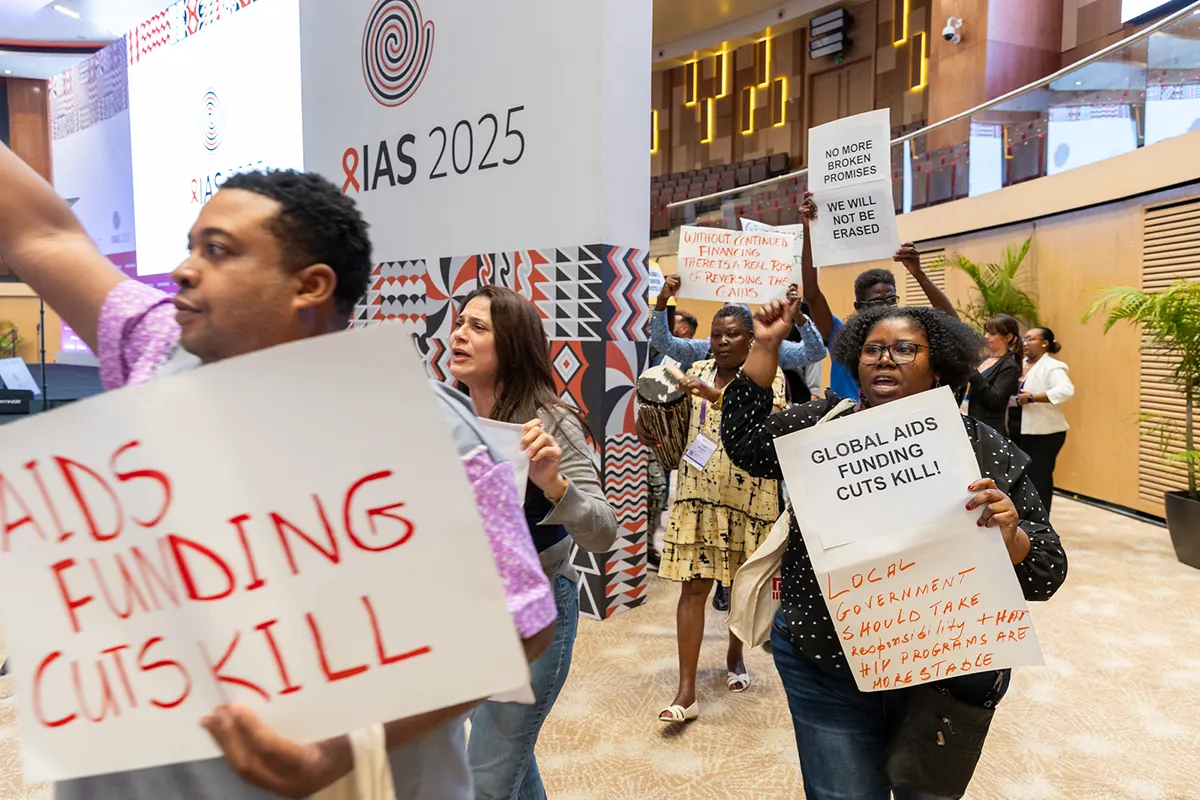
Protesters voice anger over US aid funding cuts to global HIV programs in low to middle income countries.
US aid funding cuts: A global threat to HIV programs
At IAS 2025, delegates warned that US aid cuts disrupt HIV treatment, prevention, and research worldwide. A 90-day freeze in January stalled services in low- and middle-income countries, while proposed PEPFAR cuts risked millions of new infections and deaths by 2029. Although $400m was reinstated, funding remains below past levels, threatening 27 HIV cure trials in South Africa alone.
Delegates called for greater global collaboration to reduce reliance on US aid.

What’s next?
IAS 2025, with nearly 4000 delegates and many more online, showed HIV science is stronger than ever. Long-acting PrEP, new HIV treatments, and cure research are advancing—but all depend on sustained funding. At the closing, IAS President Beatriz Grinsztejn looked to AIDS 2026 conference in Rio, urging the HIV community: ‘The science is ready. Are we?’ and called for renewed strategies, restored services, and collective strength.
Links
Watch the IAS 2025 conference sessions (open to the public from 17/9/2025)
Review of Data Presented at IAS 2025 by IAS-USA
Watch the webinar recording: HIV Science from IAS2025 Unpacked
(with special guest HIV cure researcher: Dr Jillian Lau. Hosted by Positive Women Victoria)
Read ‘One Pill, Once A Week’ – read about the experiences of two people with HIV enrolled in LEN/ISL weekly pill trial in Melbourne. Published in Positive Living.
Victorian HIV CURE Volunteer Form (sign up to receive a regular newsletter on HIV cure or to enrol in HIV cure trials if you live in Melbourne)
Related posts

Farewell, my friend
We were an item in the early eighties before we were even aware that HIV was circulating among us although we’d heard reports about this mysterious virus, initially called GRID (Gay Related Immune Deficiency) coming from the USA. When the HIV test became available in November 1984 we both made a quick dash to the […]

Heterosexual men living with HIV in Australia
The only thing worse than being talked about is not being talked about.
AIDS2026: Is HIV remission the new cure?
AIDS2026 offered a glimpse into the “just around the corner” future of HIV treatment and care.
